EV Charging Cost vs Gasoline Per Mile
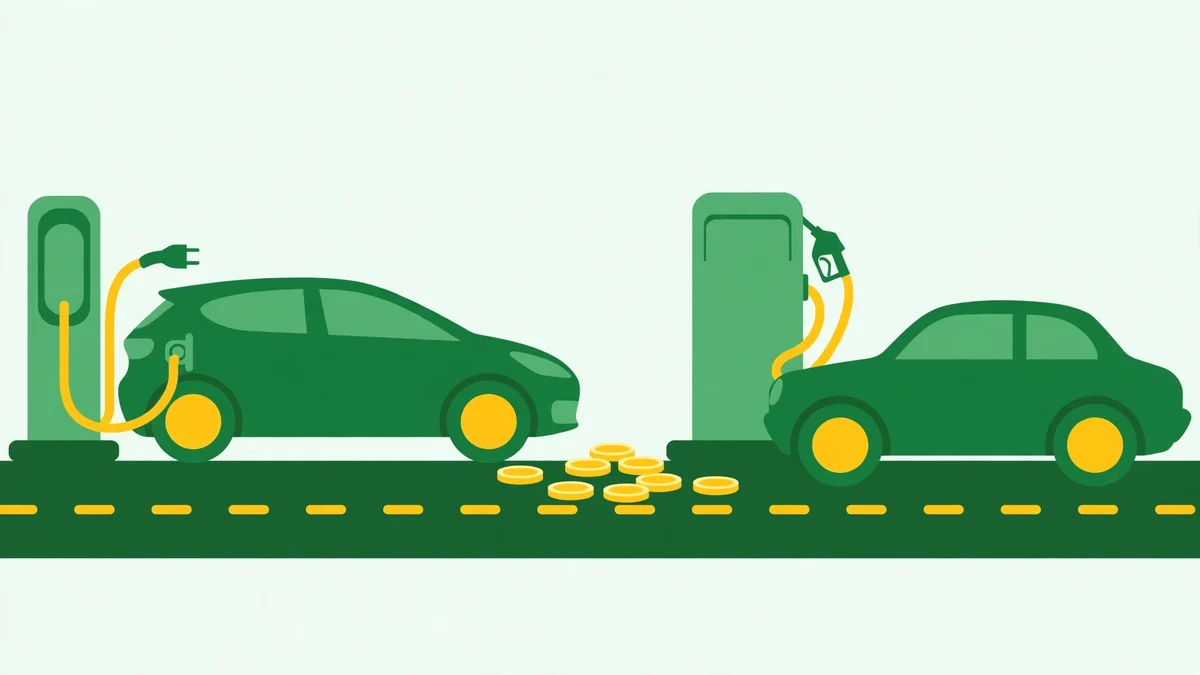
Fuel is consistently one of the largest recurring operating expenses for motor vehicle owners. With gasoline retail prices subject to global crude volatility and residential electricity billed under structured utility tariffs, comparing the operating expense of an internal combustion engine (ICE) vehicle to an all-electric vehicle (EV) requires a standardized mathematical framework. Rather than trying to compare gallons of gasoline directly to battery kilowatt-hours, drivers can calculate their exact cost per mile under their own driving habits, local fuel rates, and home charging configurations.
The fundamental per-mile cost formulas
Determining operating fuel costs starts with simple per-mile equations that enable direct comparisons regardless of vehicle size, battery capacity, or fuel tank volume.
For a gasoline vehicle, the calculation requires only the retail price of gasoline and fuel economy:
Gasoline Cost per Mile ($/mi) = Gasoline Price per Gallon ($/gal) / Fuel Economy (MPG)
For example, if gasoline costs a hypothetical $3.50 per gallon and a sedan averages 30 MPG, the fuel cost is $3.50 divided by 30, which equals approximately $0.1167 per mile (11.7 cents per mile).
For an electric vehicle, the formula uses electrical consumption and your electricity tariff:
EV Cost per Mile ($/mi) = Energy Consumption per Mile (kWh/mi) * Electricity Price ($/kWh)
Because official window stickers display consumption per 100 miles, you can rewrite the formula as: EV Cost per Mile = [(kWh per 100 miles) / 100] * Electricity Price ($/kWh). If an EV consumes 30 kWh per 100 miles (0.30 kWh/mi) and charges at home at the preliminary August 2026 U.S. average residential rate of about 18.16 cents per kWh (from EIA Table 5.6.A), the base fuel cost is 0.30 * $0.1816, resulting in approximately $0.0545 per mile (5.45 cents per mile).
Understanding EV efficiency: kWh per 100 miles vs MPGe
The U.S. Environmental Protection Agency (EPA) reports electric vehicle efficiency on window stickers and FuelEconomy.gov using two metrics: Miles Per Gallon equivalent (MPGe) and kilowatt-hours per 100 miles (kWh/100 mi).
MPGe was developed to provide a familiar benchmark for drivers transitioning from gasoline. The EPA established that 33.7 kilowatt-hours of electricity represents the thermal energy equivalent of one gallon of gasoline. An EV rated at 112 MPGe travels 112 miles on 33.7 kWh of electricity.
While MPGe helps compare overall efficiency across vehicle classes, kilowatt-hours per 100 miles is the practical metric for budgeting running costs. Because utilities bill customers per kilowatt-hour, knowing your vehicle's kWh consumption allows direct calculation of electric bills. FuelEconomy.gov lists each EV's rating in kWh per 100 miles, so look up the specific vehicle rather than assuming a typical figure.
Home charging economics: Level 1 vs Level 2 and time-of-use rates
According to the Alternative Fuels Data Center (AFDC), the vast majority of EV charging occurs at home, where electricity prices are typically lowest. Residential charging falls into two equipment tiers:
- Level 1 Charging (120V): Uses a standard 120-volt household receptacle, adding about 2 to 5 miles of range per hour of charging. While equipment costs are minimal because vehicles include a 120V cord, charging is slow and best suited for low daily mileage or plug-in hybrids.
- Level 2 Charging (240V): Uses a dedicated 240-volt circuit, adding 15 to 30 or more miles of range per hour. Installing a Level 2 unit requires dedicated wiring and upfront equipment, but allows convenient overnight recharging.
Homeowners can often lower charging costs through utility time-of-use (TOU) rates. Under TOU tariffs, utilities charge lower rates during off-peak overnight hours when grid demand is reduced. Scheduling your EV or charger to run during off-peak windows lowers your effective per-kWh charging rate.
Public DC fast charging and blended charging costs
Long-distance travel or living without home charging access requires public charging infrastructure. Public DC fast charging (Level 3) supplies high-voltage direct current directly to the battery, and charging speed varies by vehicle and charger.
However, public DC fast charging usually costs significantly more per kilowatt-hour than residential electricity. Commercial operators must recover investments for high-power equipment, utility demand charges, and site leases. In many areas, fast charging rates reach 35 to 50 cents or more per kilowatt-hour.
To calculate operational costs accurately, compute a blended electricity rate based on your expected charging mix:
Blended Rate ($/kWh) = (Home Charging Share * Home Rate) + (Public Charging Share * Public Rate)
For example, if a driver charges 85% at home at $0.1816 per kWh and 15% at public fast chargers at a hypothetical $0.42 per kWh, the blended fuel cost is (0.85 * 0.1816) + (0.15 * 0.42) = $0.1544 + $0.0630 = $0.2174 per kWh. Omitting public charging costs creates an unrealistically optimistic projection of fuel savings.
Real-world variables: Charging losses and cold weather
Real-world electricity consumption often exceeds window-sticker ratings due to physical energy losses:
- Charging efficiency losses: When alternating current (AC) power travels through the onboard charger into the battery pack, energy is lost as heat during AC-to-DC conversion and thermal regulation. These losses vary by charger, temperature and battery state; a commonly cited rough range is 10% to 15%, which is an estimate rather than a measured figure for any particular car. Drawing 30 kWh into a battery pack may require drawing 33 to 35 kWh from the electrical grid, which appears on your utility bill.
- Cold weather impacts: In freezing weather, chemical reactions within lithium-ion cells slow down. In addition, electric vehicles must draw battery power for cabin heating, as they lack waste engine heat. Winter driving conditions can noticeably increase energy consumption per mile.
- Highway driving speeds: Aerodynamic drag increases at higher velocities. Driving at 75 mph consumes considerably more energy per mile than suburban stop-and-go driving, where regenerative braking recovers kinetic energy.
Hypothetical worked example: 12,000 annual miles compared
To see how these variables interact, consider a worked comparison based on 12,000 annual driving miles, using clearly hypothetical fuel prices:
| Parameter | Hypothetical Gasoline Sedan | Hypothetical Electric Sedan |
|---|---|---|
| Fuel Economy | 30.0 MPG | 30.0 kWh / 100 miles (0.30 kWh/mi) |
| Adjusted Consumption (12% Charging Loss) | Not applicable | 0.336 kWh pulled from grid / mile |
| Unit Fuel Price | $3.50 / gallon | $0.2034 / kWh blended rate (90% home @ $0.1816, 10% public @ $0.40) |
| Operating Cost per Mile | $0.1167 / mile | $0.0683 / mile |
| Annual Fuel Units Consumed | 400.0 gallons | 4,032.0 kWh |
| Annual Operating Fuel Cost | $1,400.00 | $820.11 |
| Annual Fuel Difference | Baseline | $579.89 savings |
In this hypothetical scenario, the electric vehicle provides annual fuel savings of approximately $579.89 ($1,400.00 vs $820.11), or roughly 4.84 cents per mile. You can model your own driving mileage and utility rates using our interactive EV vs gas cost per mile calculator.
Maintenance differences and vehicle purchase payback
Operating costs extend beyond fuel to scheduled maintenance. Electric vehicles eliminate many mechanical components found in combustion vehicles, including engine motor oil, spark plugs, timing belts, and exhaust systems. Furthermore, regenerative braking redirects kinetic energy back into the battery pack, reducing brake pad and rotor wear.
However, electric vehicles are generally heavier due to battery weight and deliver instant motor torque, which can increase tire wear. Factoring in routine maintenance gives a balanced view of total ownership expenses.
When evaluating the financial payback of an EV purchase, drivers compare annual operating savings against any upfront price premium: Payback Years = Net Purchase Price Difference / Annual Operating Savings.
When budgeting an EV purchase, note federal tax incentive timelines. Under IRS guidelines, federal clean vehicle credits (both the new clean vehicle credit and the previously owned clean vehicle credit) applied only to vehicles acquired on or before September 30, 2025. Per official IRS documentation, no federal clean vehicle tax credits exist for vehicles acquired after that date. Buyers should verify whether state-level rebates or local utility discounts remain available in their jurisdiction before purchasing.
Common mistakes
Motorists comparing electric and gasoline operating costs frequently make several analytical errors:
- Relying exclusively on EPA window sticker MPGe: Calculating fuel savings using MPGe rather than your actual local residential electricity rate in cents per kWh leads to inaccurate cost projections.
- Assuming 100% home charging at off-peak rates: Drivers who frequently travel long distances and rely on public fast chargers often face substantially higher per-kWh charging rates.
- Ignoring charging efficiency losses: Omitting the energy lost during charging (roughly 10% to 15% is a common rough estimate) understates actual grid electricity consumption on your utility bill.
- Overlooking cold-weather range declines: Failing to anticipate winter heating penalties and reduced battery efficiency can lead to unexpected seasonal spikes in charging costs.
- Assuming federal clean vehicle tax credits are still active: Factoring expired federal tax credits into vehicle purchase budgets distorts upfront pricing calculations.
- Neglecting electric rate tier shifts: Adding charging load to your home can push consumption into higher tiered rate brackets. Review our guide on understanding your electric bill and kWh rates to evaluate marginal rate impacts.
Bottom line
Comparing electric vehicle charging costs against gasoline per mile requires looking past simplified generalizations. While electric powertrains offer superior mechanical efficiency and typically provide lower per-mile fuel costs when charged at residential electricity rates, overall financial savings depend heavily on local gasoline prices, electricity tariffs, and the proportion of charging completed at home versus public DC fast chargers. By calculating your personal cost per mile and accounting for real-world charging losses, you can make an informed vehicle purchasing decision tailored to your driving habits.
This article is provided for educational purposes only and does not constitute financial, tax, legal, or automotive engineering advice.