Heat Pump vs Furnace: Comparing Running Costs
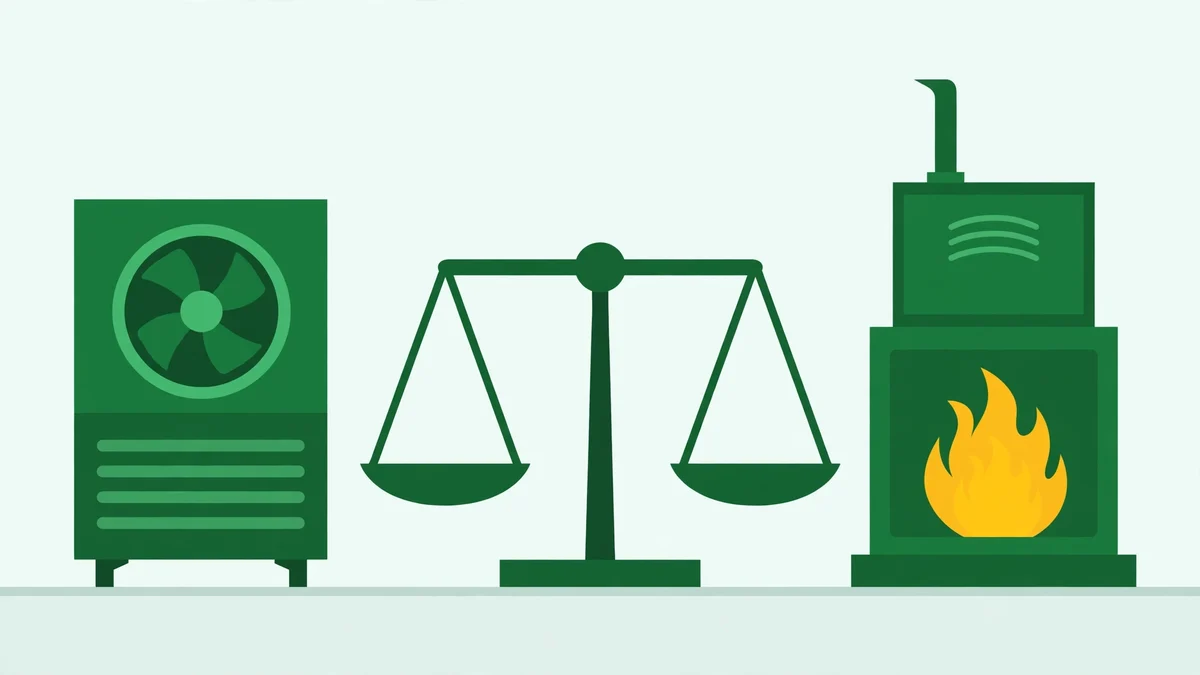
Evaluating the running cost of an electric heat pump versus a combustion furnace is a central financial decision for homeowners. While a gas or oil furnace burns fuel to create heat, an electric heat pump uses a refrigeration cycle to transfer ambient heat from outdoor air inside. Because these systems use different fuels metered in different units, identifying the more economical choice requires standardizing energy prices into the cost of delivered thermal energy.
Energy units and fuel conversion math
To compare heating fuels accurately, each energy source must be converted into a common thermal measurement: the British Thermal Unit (Btu). One Btu represents the thermal energy required to raise the temperature of one pound of water by one degree Fahrenheit. Large heating loads are benchmarked in millions of Btu (MMBtu), where 1 MMBtu equals 1,000,000 Btu.
Utility bills report energy consumption in specialized commercial units. Official conversion values from the U.S. Energy Information Administration (EIA) include:
- Electricity: 1 kWh = 3,412 Btu.
- Natural gas: 1 therm = 100,000 Btu.
- Propane: 1 gallon is approximately 91,500 Btu.
- Heating oil: 1 gallon of distillate fuel oil is approximately 138,500 Btu.
Comparing raw rates directly—such as cents per kilowatt-hour to dollars per therm—is misleading. One therm of natural gas contains nearly 29.3 times as much raw energy as one kilowatt-hour of electricity (100,000 / 3,412). Calculating delivered cost per MMBtu resolves these differences.
Efficiency metrics: AFUE vs COP and HSPF2
Raw fuel energy does not translate entirely into indoor warmth. Heating systems lose energy through exhaust gases, thermal transfer, or friction, which is captured in standardized efficiency ratings.
Combustion furnaces are rated by Annual Fuel Utilization Efficiency (AFUE), the percentage of fuel energy converted into usable space heat over a season. A baseline furnace carries an 80% AFUE rating, losing 20% of fuel energy through the chimney. High-efficiency condensing furnaces achieve 95% to 98% AFUE by extracting additional heat from exhaust water vapor.
Electric systems operate under distinct metrics:
- Electric resistance heating: Baseboard units and electric furnaces carry a Coefficient of Performance (COP) of 1.0 (essentially 100% efficient). Each kilowatt-hour (3,412 Btu) consumed produces exactly 3,412 Btu of heat.
- Air-source heat pumps: Because heat pumps transfer existing outdoor heat rather than creating it, seasonal COP is commonly well above 1 in mild-to-moderate climates. A COP of 3.0 indicates the unit delivers 3.0 units of heat per unit of electricity used. However, efficiency drops in very cold weather.
- HSPF2 and SEER2: Heat pump heating performance is formally rated using Heating Seasonal Performance Factor 2 (HSPF2), measuring seasonal Btu output divided by watt-hours consumed. Cooling efficiency is measured by SEER2.
Delivered cost per MMBtu: A worked hypothetical comparison
The standard formula for calculating delivered heating costs is: Delivered Cost per MMBtu = [Fuel Price per Unit / (Btu per Unit / 1,000,000)] / Efficiency.
To demonstrate the math, consider a set of clearly hypothetical prices across common fuels. According to preliminary data from the EIA Electric Power Monthly (Table 5.6.A), the U.S. average residential electricity price was about 18.16 cents per kWh in August 2026, though local utility rates vary widely. Using this figure alongside representative fossil fuel prices produces the following comparison:
| Heating System & Fuel | Hypothetical Fuel Rate | Efficiency | Delivered Cost per MMBtu |
|---|---|---|---|
| Electric Resistance Heat | $0.1816 / kWh | COP 1.0 | $53.22 |
| Heat Pump (Moderate Weather) | $0.1816 / kWh | COP 3.0 | $17.74 |
| Heat Pump (Mild Weather) | $0.1816 / kWh | COP 3.5 | $15.21 |
| Standard Natural Gas Furnace | $1.50 / therm | 80% AFUE | $18.75 |
| Condensing Natural Gas Furnace | $1.50 / therm | 96% AFUE | $15.63 |
| Propane Furnace | $3.00 / gallon | 85% AFUE | $38.57 |
| Heating Oil Furnace | $3.80 / gallon | 85% AFUE | $32.28 |
In this hypothetical scenario, running electric resistance costs $53.22 per MMBtu ($0.1816 / 0.003412). Running a heat pump at a seasonal COP of 3.0 reduces that cost to $17.74 per MMBtu. Meanwhile, a 96% AFUE condensing gas furnace delivers heat at $15.63 per MMBtu ($1.50 / 0.1 / 0.96). Propane ($38.57) and heating oil ($32.28) cost substantially more per delivered unit of heat, which is why the calculator compares your own fuel and electricity prices rather than assuming a result.
The break-even electricity-to-gas price ratio
To identify the electricity price where running a heat pump costs the same as running a natural gas furnace, you can solve for the break-even rate: Break-Even Electricity Price ($/kWh) = (Gas Price per Therm / 100,000) * 3,412 * (Heat Pump COP / Furnace AFUE).
Using our hypothetical inputs of $1.50 per therm for gas, a 96% AFUE furnace, and a heat pump seasonal COP of 3.0:
- Cost per raw gas Btu: $1.50 / 100,000 = $0.000015.
- Efficiency ratio: 3.0 / 0.96 = 3.125.
- Break-even rate: $0.000015 * 3,412 * 3.125 = $0.1599 per kWh (roughly 16.0 cents per kWh).
If your electricity rate is below 16.0 cents per kWh under these conditions, the heat pump provides lower running costs per MMBtu. If your local electric tariff exceeds 16.0 cents, the condensing gas furnace produces lower operating costs. You can test your household numbers with the heat pump vs furnace cost calculator.
Cold climates, backup heat, and defrost cycles
A heat pump's instantaneous COP shifts with outdoor ambient temperatures. As outside air gets colder, less thermal energy is available to absorb, requiring the compressor to work harder. While cold-climate heat pumps maintain capacity in freezing conditions, efficiency drops during severe cold snaps.
When heating demand exceeds heat pump output at low temperatures, supplemental backup systems engage:
- Electric auxiliary resistance strips: Many air handlers house electric resistance coils. When temperatures fall below the balance point, these coils activate at a COP of 1.0, which can increase winter electric bills if used frequently.
- Dual-fuel hybrid setups: A heat pump can be paired with an existing gas or propane furnace. The system switches from the heat pump to the furnace when outdoor temperatures fall below a preset balance point.
- Defrost cycles: Outdoor coils accumulate frost during freezing weather. The system periodically reverses operation to defrost the coil, using a small amount of additional energy.
Ductwork, electrical service, and Manual J load calculations
Equipment efficiency is only as good as the system design. Combustion furnaces produce high-temperature air (typically 120 to 140 degrees Fahrenheit) in short cycles, while heat pumps deliver air at milder temperatures (typically 90 to 105 degrees Fahrenheit) over longer, continuous cycles.
Because supply air temperatures are lower, heat pumps often circulate a greater volume of air (CFM) to satisfy heating demand. If existing ducts are undersized or leaky, system performance can suffer, so ask a qualified contractor to evaluate them.
Proper sizing requires a formal load calculation under the ACCA Manual J standard. A Manual J calculation analyzes building square footage, insulation levels, window orientation, and local climate data. Oversizing equipment based on crude square-footage estimates causes short-cycling and uneven temperatures. Additionally, installing a heat pump with electric resistance backup may require upgrading electrical service panels to accommodate 40- to 60-amp auxiliary circuits.
Installation costs, incentives, and simple payback
Operating costs must be weighed alongside upfront equipment and installation pricing. Homeowners calculate financial return using simple payback: Simple Payback (Years) = Net Incremental Installation Cost / Annual Operating Savings.
When evaluating incentives, federal statutory deadlines must be noted carefully. The Energy Efficient Home Improvement Credit (Section 25C) applied to qualifying improvements made through December 31, 2025. Per official IRS documentation, Section 25C is not available for property placed in service after 2025. Therefore, economic models for post-2025 installations should not incorporate federal tax credits.
However, state, municipal, and utility rebates may still be available. Many electric utilities offer equipment rebates or discounted winter heating rates for qualifying heat pump models. Homeowners can search the Database of State Incentives for Renewables & Efficiency (DSIRE) or contact their utility to verify local opportunities.
Common mistakes
Homeowners evaluating heating systems commonly make several key errors:
- Comparing unit rates without Btu conversion: Evaluating cents per kWh directly against dollars per therm ignores differences in fuel energy density and equipment efficiency.
- Assuming constant heat pump efficiency: Failing to account for efficiency declines during severe sub-freezing weather distorts annual operating projections.
- Relying excessively on electric resistance backup: Improper thermostat settings or poor equipment sizing can cause expensive auxiliary heat strips to run excessively.
- Skipping a Manual J load calculation: Relying on rule-of-thumb sizing leads to improperly sized equipment that compromises comfort and shortens component life.
- Assuming federal tax credits are ongoing: Counting on expired federal Section 25C credits for installations after 2025 creates inaccurate payback expectations.
- Ignoring building envelope air leakage: Upgrading heating equipment without addressing drafty doors and windows diminishes heating savings. Review our winter heating cost tips to identify envelope improvements.
Bottom line
Determining whether an electric heat pump or a combustion furnace offers lower running costs requires analyzing local utility rates, regional winter temperatures, and existing heating infrastructure. Heat pumps provide remarkable seasonal efficiency by moving thermal energy rather than burning fuel, delivering compelling running cost reductions when replacing propane, fuel oil, or electric baseboard systems. When comparing heat pumps against low-cost natural gas, running costs are often comparable, making dual-fuel configurations an attractive hybrid option for many households.
This article is provided for educational purposes only and does not constitute financial, tax, legal, or energy engineering advice.